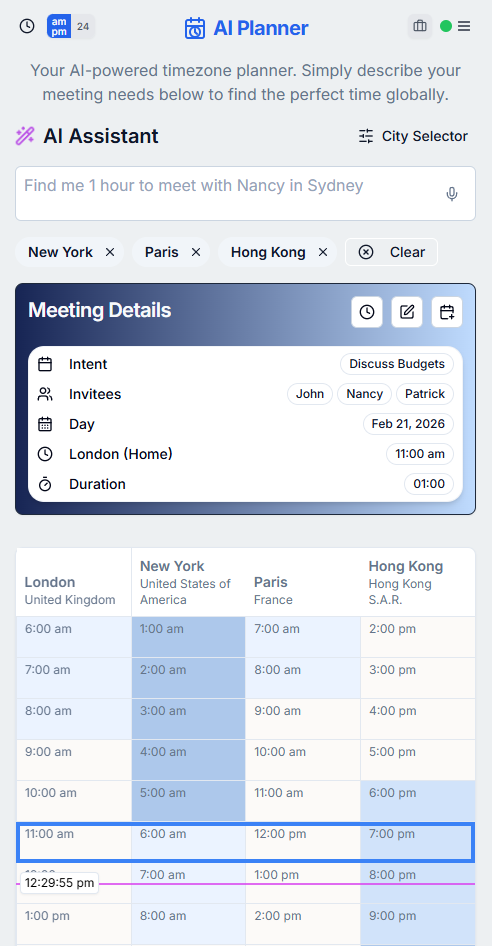
Convert by city whenever possible
City-based conversion is more reliable than abbreviation-based conversion. For example, CST can refer to different regions depending on context, while Chicago, Mexico City, and Beijing are specific places with specific rules.
WorldTimePlanner uses city and timezone data so you can convert from one location to another without guessing which abbreviation someone meant.
Daylight saving time changes the answer
Some countries move clocks forward or backward, and others do not. Even when two cities usually have a familiar offset, that offset can temporarily change during daylight saving transitions.
This is why international meeting planning should be checked close to the actual meeting date. A time that worked last month may not be the same after a regional clock change.
Compare more than two locations
Many converter tools are built around one source time and one destination time. That is useful, but remote teams often need to compare several locations at once.
WorldTimePlanner is designed for that multi-city problem. Add the cities involved, review the local timeline, and use the planner to find a time that is reasonable across the group.
Frequently asked questions
Why do timezone converters sometimes disagree?
They may use different assumptions about the date, daylight saving time, or ambiguous abbreviations. City-based conversion with a meeting date is more reliable.
What is the difference between UTC and local time?
UTC is a global reference time. Local time is the clock time used in a specific place, including its offset and daylight saving rules.
Can I compare several cities at once?
Yes. WorldTimePlanner is built for comparing multiple cities in one view instead of converting only one pair at a time.